 A Veteran Owned Business
A Veteran Owned Business
A Veteran Owned Business

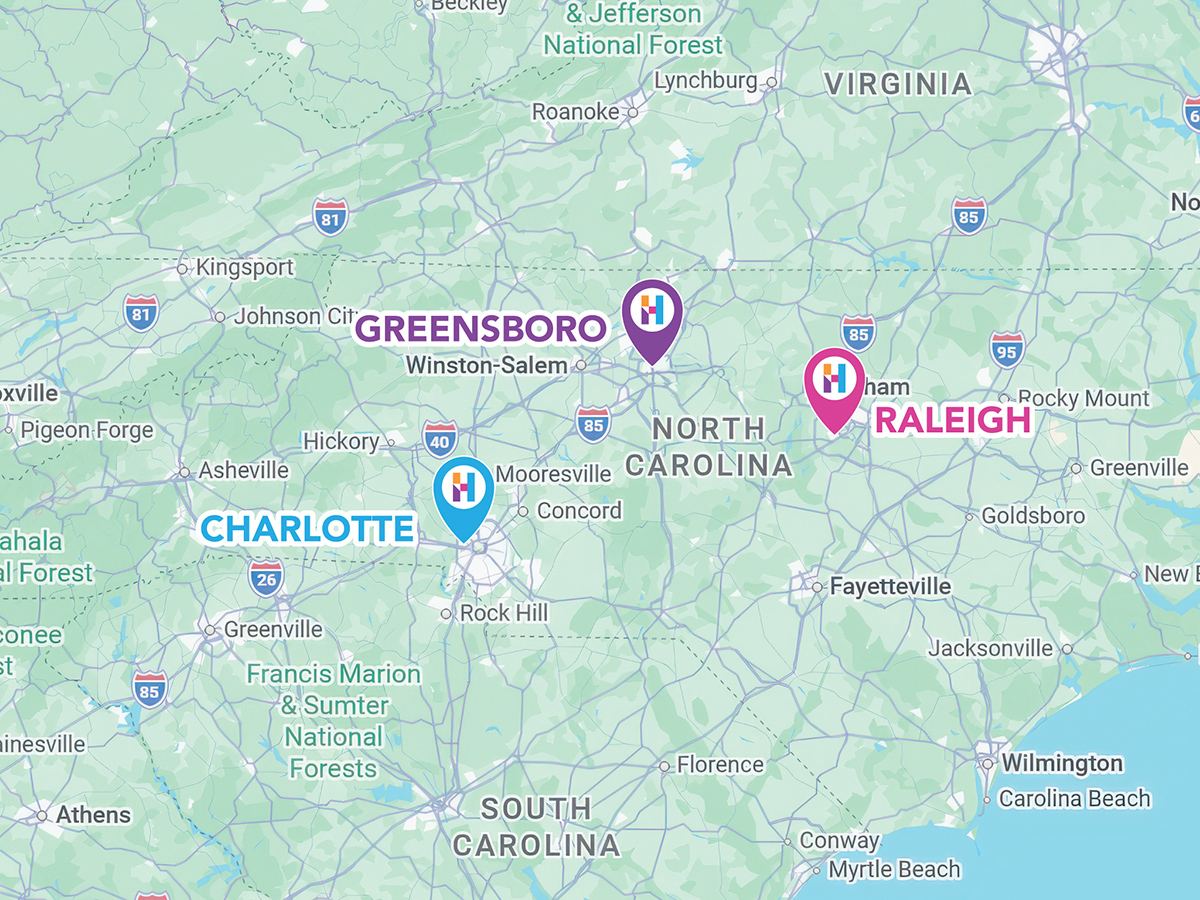
Raleigh and Greensboro field support connects Carolinas projects with production and regional resources.
Real Local Support Without Inventing Local Offices
The best location network is one that gives a client real support near the project without creating confusion about where Heritage actually has offices or production resources. Across Heritage's Carolinas markets, Raleigh and Greensboro provide genuine local field presence in two important regions, while Charlotte provides the headquarters and primary production backbone for the Carolinas. Raleigh anchors the Research Triangle with client-facing support, site surveys, field verification, installation planning, professional installation, and follow-through. Greensboro provides comparable local support for the Piedmont Triad. Greenville-Spartanburg and Upstate South Carolina, along with Columbia and the South Carolina Midlands, are supported through coordinated Carolinas resources, but South Carolina is service geography rather than a current Heritage office state. This page is designed to make those distinctions useful to clients. It explains where Heritage has people close to the site, where production support comes from, and how one dedicated Project Manager can connect local needs with the broader Heritage network when a project spans several markets or locations in practice.
Raleigh, North Carolina
Client-facing office and local field and installation hub for the Research Triangle
The Raleigh team supports meetings at client facilities, discovery, site surveys, field verification, installation planning, professional installation, and follow-through.
Greensboro, North Carolina
Client-facing office and local field and installation support for the Piedmont Triad
The Greensboro team supports local discovery, site surveys, installation planning, professional installation, and follow-through across Greensboro, Winston-Salem, High Point, and nearby Triad communities.
Charlotte, North Carolina
Heritage headquarters and primary specialty production facility
Charlotte anchors the Carolinas production system and also has Charlotte-region client, project, field, and installation resources.
Raleigh and Greensboro are not simply names used to support local search. They are verified client-facing Heritage locations with real field and installation roles. Raleigh serves Raleigh, Durham, Chapel Hill, Cary, Morrisville, Research Triangle Park, and the broader Research Triangle through local discovery, meetings at client facilities, site surveys, field verification, installation planning, professional installation, and follow-through. Greensboro supports Greensboro, Winston-Salem, High Point, and the Piedmont Triad with the same kind of practical site-level involvement. That local presence matters because branded workplace interiors and event environments depend on conditions that are difficult to understand from a drawing alone, including dimensions, surfaces, access, existing conditions, installation timing, and how people actually use the space. Keeping field knowledge close to the project gives the dedicated Project Manager better information for design, production, fabrication, and scheduling decisions. It also gives clients a real local connection without implying that every Heritage office is a production facility or that every market operates in exactly the same way from project start.
Heritage serves clients through seven locations across North Carolina, Virginia, Maryland, and Washington, DC. This network helps Heritage stay close to workplace interior project sites through site surveys, field verification, and local installation support, while connecting each project to the production resources needed for fabrication, scheduling, and quality control.
Please note: Heritage locations are available by scheduled appointment. Since branded workplace interiors depend on the actual site, our team often reviews the client’s space, wall conditions, glass, access requirements, measurements, and installation needs before production begins.
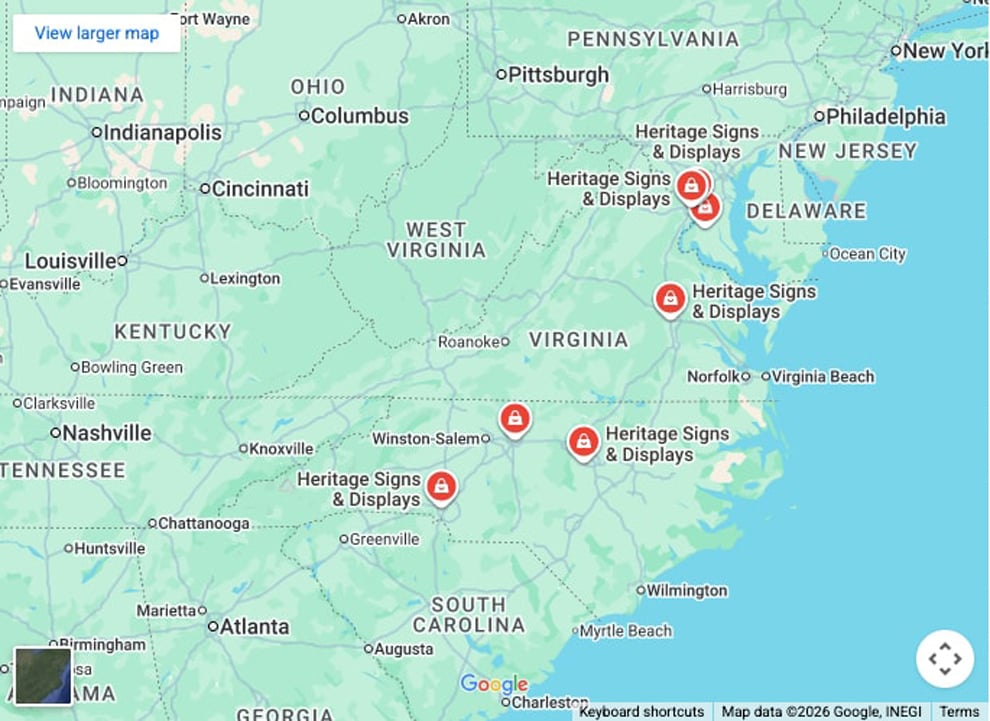
Heritage also serves important Carolinas markets where there is no physical Heritage office. Greenville-Spartanburg and Upstate South Carolina, together with Columbia and the South Carolina Midlands, are supported through coordinated Carolinas resources. Charlotte provides the principal production backbone, while the project can draw on the Heritage people, field planning, and installation resources appropriate to the actual location and scope. We should be direct about that distinction: South Carolina is a Heritage service geography, not a current office state. Clear geography is better for the client than creating the appearance of a local office that does not exist. The same principle applies throughout the network. Website market ownership, client-facing support, professional installation, and production location are different facts, and Heritage should explain each accurately. For the client, the important question is not whether every service occurs under one roof. It is whether the right people have the right project information and whether local site realities stay connected to design, production, fabrication, scheduling, and installation decisions responsibly.
Washington, DC
Client and field support for the DC metro.
Arlington, Virginia
Field and installation support for Northern Virginia and the Washington, DC region.
Richmond, Virginia
Field and installation support for Central Virginia within Heritage's Mid-Atlantic network.
Waldorf, Maryland
Production-only Mid-Atlantic facility staffed by production team members. Waldorf is not a sales office or showroom.
When a client operates across several Carolinas markets, the location network should reduce coordination work rather than create more of it. Heritage's One Dedicated Project Manager System keeps one person responsible for carrying the program history forward while Heritage teammates closer to each property contribute the field support the site actually needs. A Raleigh office may require one installation approach, a Greensboro facility another, and a South Carolina property a different travel, access, or scheduling plan. The Project Manager keeps the approved brand direction, priorities, production expectations, and decision history connected while those local differences are resolved. Charlotte can provide the principal Carolinas production backbone, and other Heritage resources can participate when the project benefits from their equipment, capacity, or expertise. This structure lets a client expand across the Carolinas or into the Mid-Atlantic without pretending each market operates identically. The value is a coordinated Heritage relationship that preserves what should stay consistent while giving each property enough flexibility to be planned and installed responsibly.
Raleigh is Heritage's client-facing office and field and installation hub for the Research Triangle. It supports discovery at client facilities, site surveys, verification, installation planning, professional installation, and follow-through.
Greensboro provides client-facing field and installation support for Greensboro, Winston-Salem, High Point, and the surrounding Triad. That gives projects a real local field connection rather than a city name on a webpage.
Those are service markets supported through coordinated Carolinas resources. South Carolina is not a current Heritage office state, so the project plan should reflect the actual field, travel, production, and installation resources used for the work.
Charlotte is Heritage's headquarters and primary specialty production facility. It provides the main Carolinas production backbone and may handle robust or specialized work when its equipment, expertise, capacity, or workflow makes it the strongest production choice.
Because they are part of Heritage's complete seven-location network and can matter to clients operating in several regions. They are shown as broader network resources, not as Carolinas offices or proof of local presence in North Carolina or South Carolina.
A Heritage site survey is required when a project ultimately includes Heritage professional installation. The visit combines client discovery with field verification so the project record reflects reasonably observable dimensions, surfaces, access, placement, existing conditions, and installation needs.
If your project is in Raleigh, the Research Triangle, the Piedmont Triad, or another Heritage-served Carolinas market, start by sharing the location and the result you want to create. Heritage will route the opportunity to the local people and production resources that best fit the site, with one dedicated Project Manager coordinating the work. If several offices, campuses, facilities, or event locations are involved, identify them early so the team can protect brand continuity while planning each property around its own dimensions, access, audience, and installation needs.